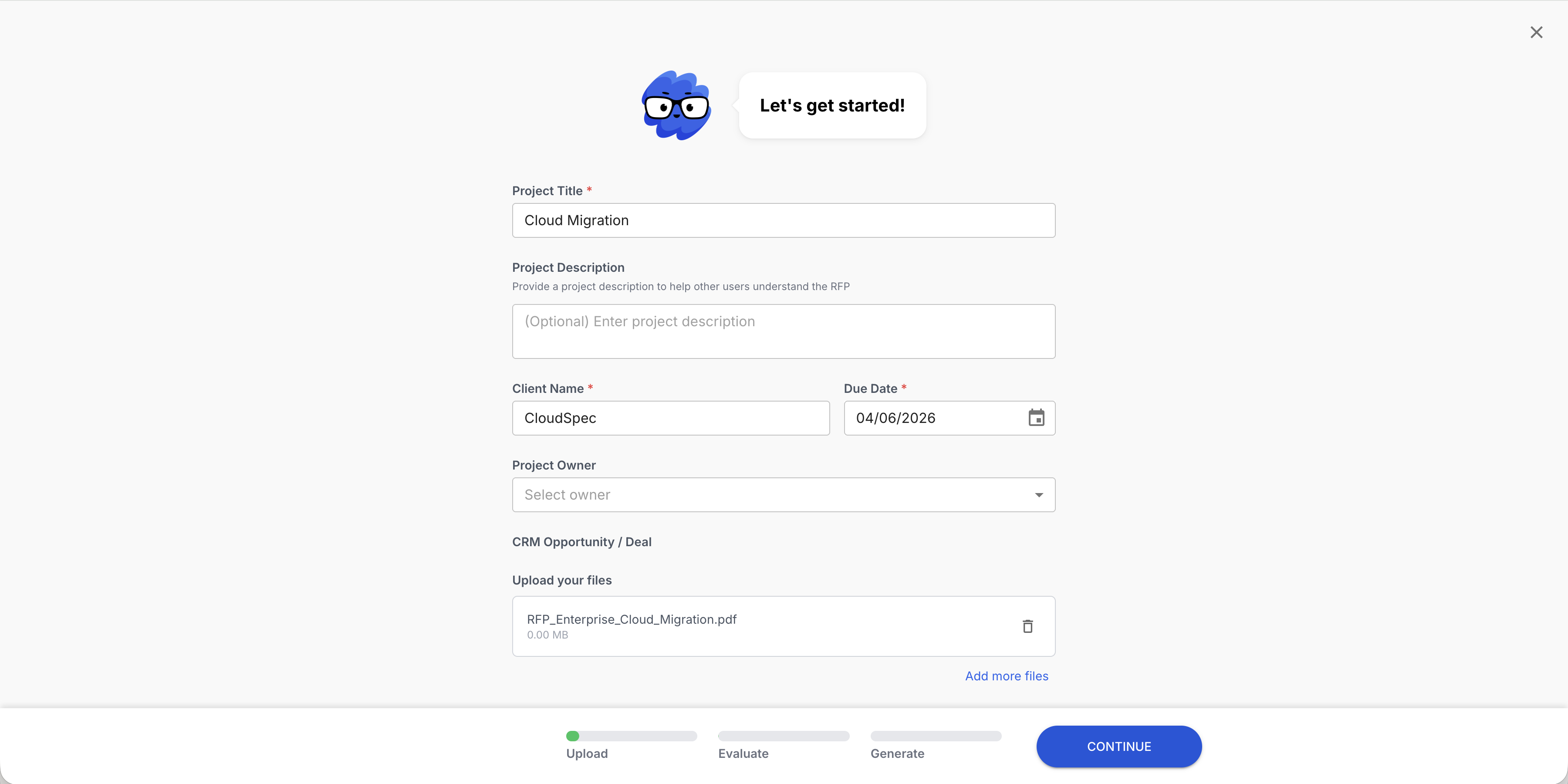
Upload. Draft. Review. Submit.
Deal intelligence for insurance teams
Carrier assessments, reinsurance DDQs, and regulatory questionnaires answered from your own policy documentation.
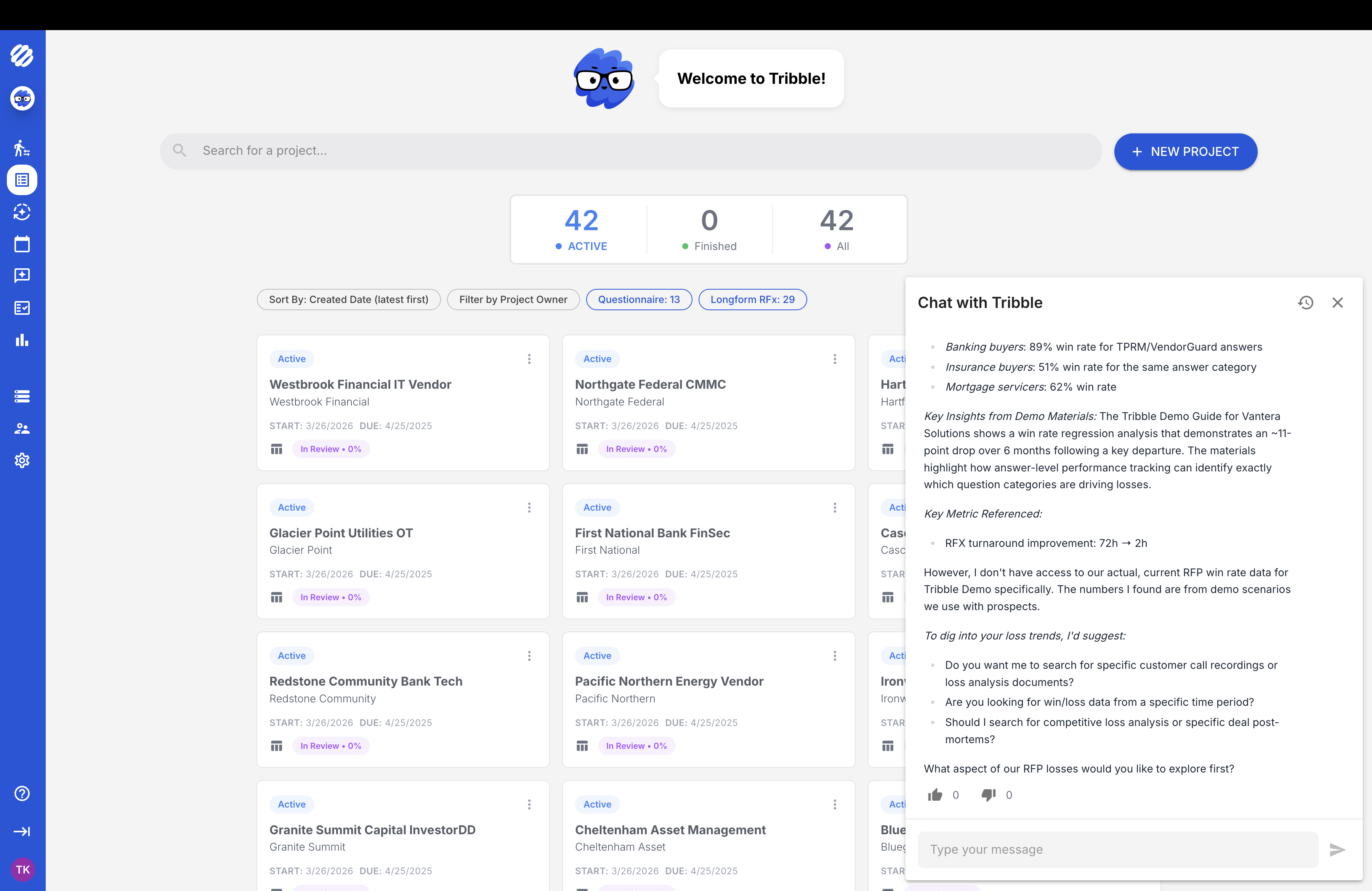
Tribble drafts sourced responses from your policy forms, actuarial documentation, regulatory filings, and prior submissions. Every answer carries a confidence score and a direct link to its source. Your compliance team reviews evidence, not boilerplate.
Responses are informed by your full product portfolio -- policy forms, endorsements, rate filings, and state-specific documentation. Every answer addresses what the carrier or regulator is actually evaluating.
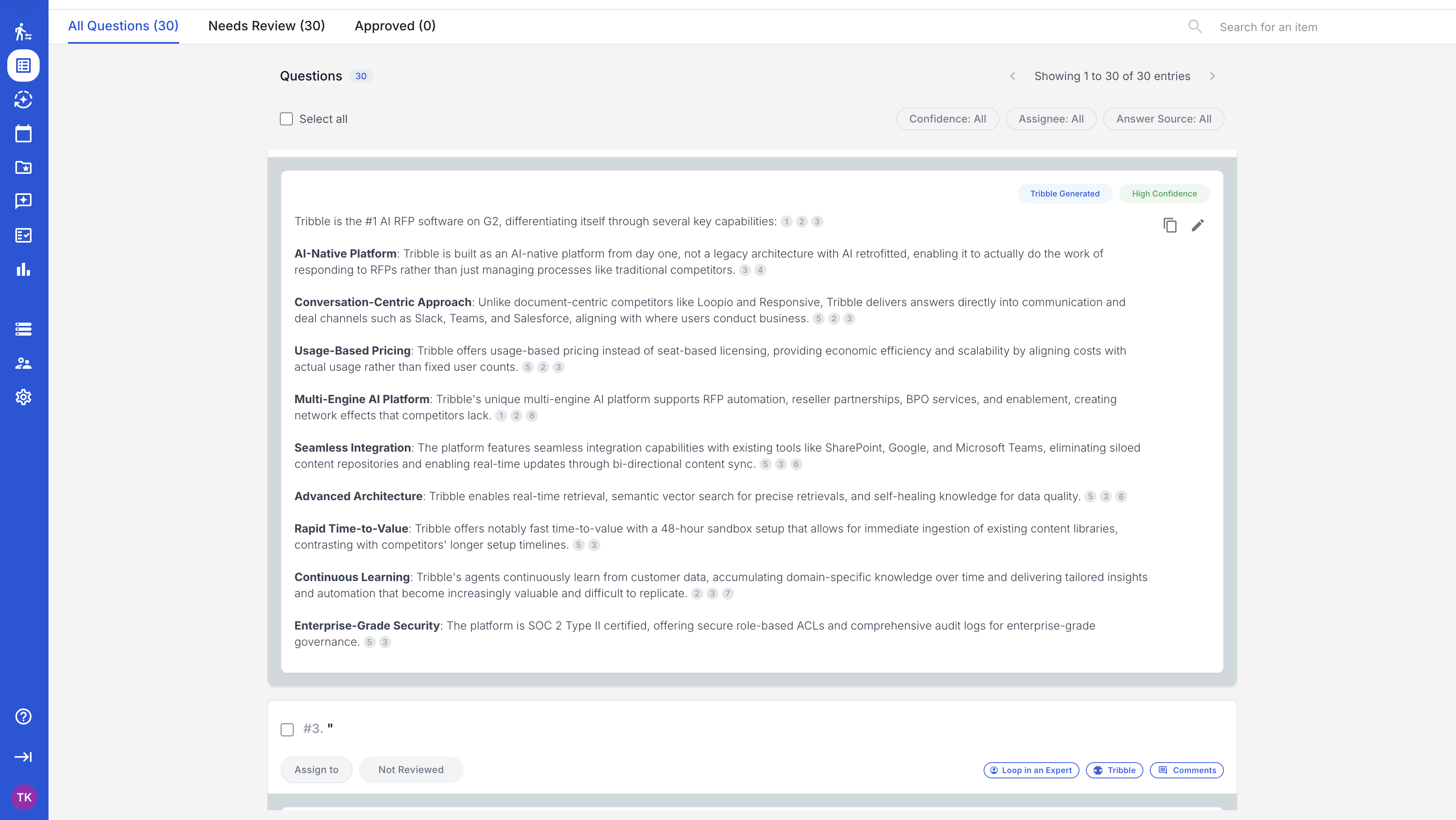
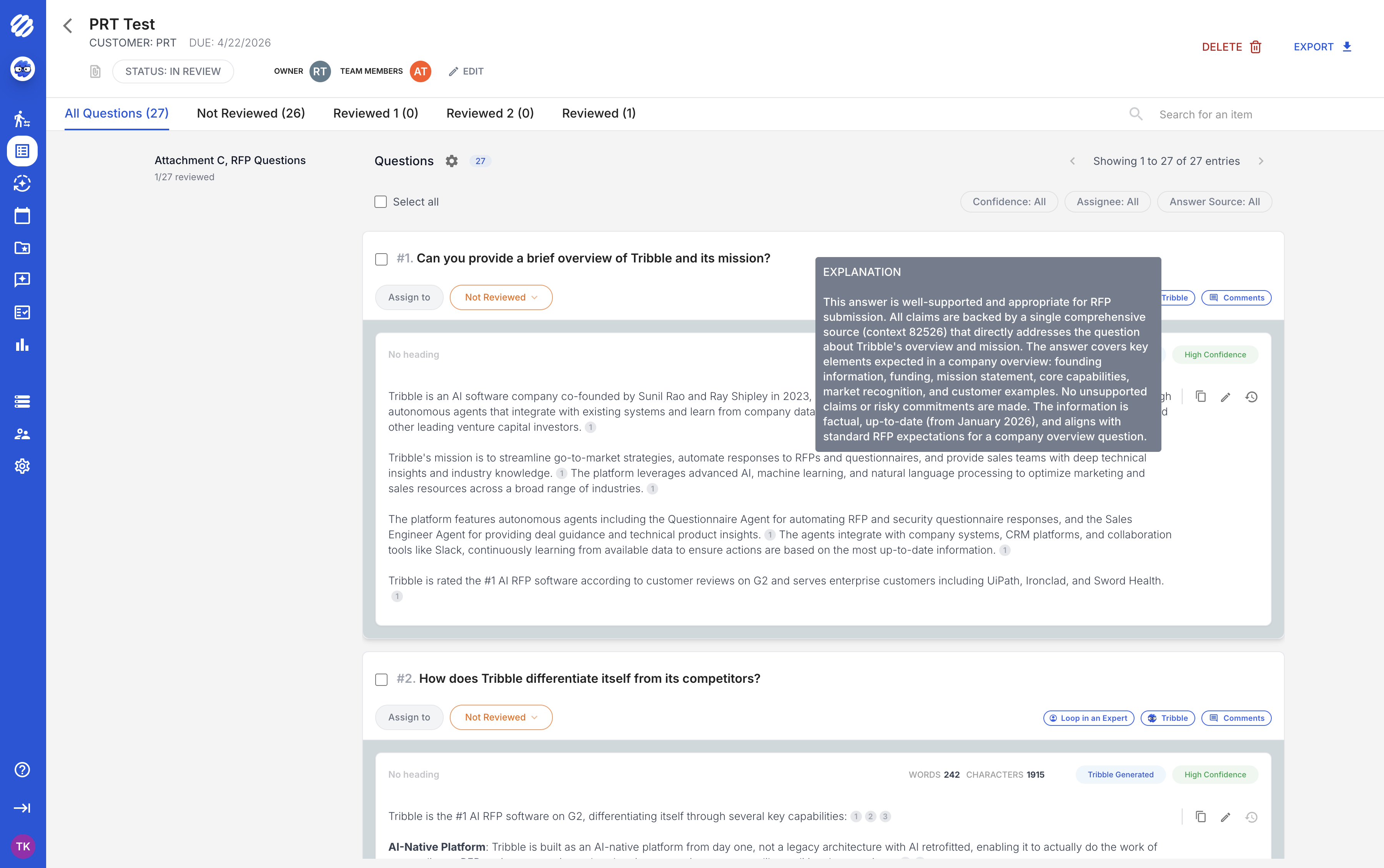
Every answer links directly to the policy form, filing, or regulatory document it was drafted from. Your compliance team sees the evidence, not just the output.
Each draft carries a per-answer confidence score. Your team knows which answers need actuarial or compliance review before they move forward.
Tribble checks every answer against every other answer in the submission. Contradictions across 200+ items are flagged before they reach the carrier or regulator.
Insurance RFPs span carriers, reinsurers, regulators, and enterprise buyers. Each has different evaluation criteria and different documentation requirements.
01 -- Carrier
Carrier RFPs demand product-specific answers spanning coverage details, underwriting criteria, claims handling procedures, and financial strength documentation. Tribble sources answers from your policy forms, endorsements, and prior carrier submissions so every coverage claim links to approved documentation.
02 -- Reinsurance
Reinsurance due diligence questionnaires require detailed responses on loss experience, reserve adequacy, underwriting philosophy, and retrocession arrangements. Tribble drafts sourced answers from your actuarial reports, treaty documentation, and prior DDQ responses -- then routes flagged items to your actuarial team.
03 -- Regulatory
State departments of insurance and NAIC assessments test compliance with market conduct standards, solvency requirements, and consumer protection regulations. Tribble sources answers from your regulatory filings and compliance documentation so every response traces to evidence your compliance team has already approved.
04 -- Enterprise
Large employers and brokers send vendor assessments covering coverage adequacy, claims SLAs, technology capabilities, and security questionnaires. Tribble handles the full spectrum -- from coverage-specific questions sourced from policy documentation to security questions sourced from your SOC 2 reports and IT policies.
Regulatory frameworks your questionnaires test against
Tribble sources questionnaire answers from your own compliance documentation and regulatory filings.
Tribble drafts policy language from your actual policy forms, endorsements, actuarial reports, and regulatory filings. Every answer cites the specific source. Your compliance and underwriting reviewers verify the citation, not the content. Teams review sourced evidence instead of rebuilding the same response from scratch.
Every answer ships with a confidence score and a direct link to the source document. Coverage claims link to policy forms. Financial strength claims link to actuarial filings. The consistency checker catches contradictions across your entire response before anyone sees it.
Tribble sources answers from your state-specific filings, compliance documentation, and prior regulatory responses. When the same question applies across multiple states with different requirements, the system flags the variance for your compliance team to review.
For insurance teams, response capacity affects more than workload. Every skipped RFP is a distribution relationship left untouched. Run your own numbers below to model the capacity impact for your team.
| Capability | Tribble | Static RFP library | Legacy response platform |
|---|---|---|---|
| AI draft from knowledge base | ✓ Full RAG with source citation | ✓ Content library + AI draft assist | ✓ Content library + AI draft assist |
| Reviewer workflow | ✓ Confidence and owner context attached | Configuration varies | Configuration varies |
| Source attribution | ✓ Every answer linked to source doc | Manual reference | Manual reference |
| Confidence scoring | ✓ Per-answer confidence | No | No |
| Internal consistency check | ✓ Cross-answer contradiction detection | No | No |
| Expert routing (Slack/Teams) | ✓ Auto-routes by question type | Alert-based | Alert-based |
| Learns from completed RFPs | ✓ Continuous learning loop | Library + some automated learning | Library + some automated learning |
| Insurance response context | Dedicated vertical | Requires manual adaptation | Configuration-dependent |
| Implementation model | ✓ Scoped around sources, workflow, and reviewers | Configuration project | Configuration project |
| SOC 2 Type II | ✓ | ✓ | ✓ |
General-purpose AI can draft text, but insurance response teams need source lineage, policy-form context, reviewer routing, and evidence compliance teams can verify.
| Tribble | DIY with ChatGPT / Claude | |
|---|---|---|
| Knowledge source | Your policy forms, actuarial docs, regulatory filings, prior winning responses | Whatever you paste into the prompt window |
| Source attribution | ✓ Every answer links to the source document | No. You get an answer with no way to verify where it came from |
| Confidence scoring | ✓ Per-answer confidence score | Requires separate review logic to expose source confidence or uncertainty. |
| Learns from your wins | ✓ Reuses approved context from completed RFPs | Requires a separate governed memory layer to preserve approved review history. |
| Cross-answer consistency | ✓ Flags contradictions across long-form answers | Requires separate checks to compare coverage details across sections. |
| Expert routing | ✓ Flags low-confidence answers to actuaries, underwriters, or compliance via Slack | You manually decide who reviews what |
| Compliance audit trail | ✓ SOC 2 Type II, answer-level audit history | Unattributed output leaves the review trail for your team to reconstruct. |
| Format handling | ✓ XLSX, DOCX, PDF, carrier portals. Parses structure automatically | You copy-paste questions one at a time |
| Total cost of ownership | Predictable subscription with implementation scoped around your sources, reviewers, and workflows | Prompt engineering, manual review, no shared audit trail, no workflow memory |
General-purpose AI generates text. Tribble generates sourced, auditable answers from your actual policy documentation that your compliance team can review with the source trail intact.
The other side of the equation
An inaccurate coverage claim, an outdated rate filing reference, a compliance statement that does not match your current filings. The carrier flags the discrepancy. Your credibility takes a hit that is hard to undo with a correction email. The ROI calculator above shows what you gain. This is what you risk every time a submission goes out without source-linked evidence.
Review your risk pointsRelated Solutions
Book a demo to see how Tribble connects approved policy documentation, drafts cited carrier RFP answers, and routes SME review.
SOC 2 Type II · SSO & RBAC · Source-cited answers · Reviewer workflow